
Beyond the Checklist: Designing Truly Inclusive Digital Experiences for Agrotourists
COMMENTS
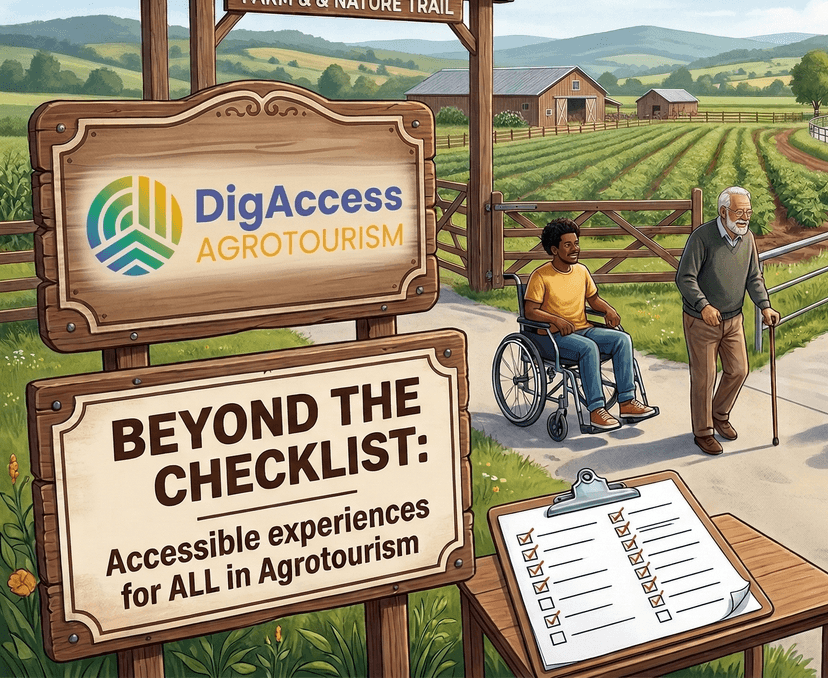
A deep dive into the UX principles that turn compliance into genuine connection — and rural tourism into a space where everyone belongs.
This is the quiet reality for millions of Europeans with disabilities every time they try to engage with rural tourism online. And it is exactly what the DigAccessAgrotourism project is working to change — not by handing out compliance checklists, but by helping agrotourism organisations build digital experiences that genuinely welcome everyone.
“Digital accessibility is not just about compliance — it’s about connection.”
What Does “Accessibility online” Really Mean?
For most small agrotourism businesses, accessibility still means physical adaptations like a ramp at the entrance or a ground-floor room. That’s a vital starting point — but it tells nothing about whether you can actually navigate the website, read seasonal menus, or book a stay independently… particular for potential clients with disability.
The international standard for web accessibility is the Web Content Accessibility Guidelines (WCAG 2.1), built around four core principles. A truly accessible website must be:
• Perceivable — information and interface components must be presented in ways all users can sense
• Operable — all functionality must be accessible via keyboard and assistive technology
• Understandable — content and navigation must be clear and predictable
• Robust — content must be compatible with current and future assistive technologies
From Principles to Practice: What Good Looks Like
Across the five countries engaged in the DigAccessAgrotourism project — Poland, Cyprus, Greece, Italy and Portugal — we have identified a rich set of real-world examples that go well beyond the minimum. They show what is possible when organisations decide that accessibility is a value, not a task.
- Portugal:
- TUR4all Platform. A collaborative, community-driven platform where travellers can report on the accessibility of tourist sites, covering physical, visual, auditory and cognitive needs in one place.
What unites these examples is not cutting-edge technology or large budgets but the intention: the choice to ask “who are we leaving out?” before a website goes live, and to act on the answer.
Three Shifts That Make the Difference
1. Start with the user, not the standard. WCAG guidelines are an excellent foundation, but the most effective accessibility improvements come from listening directly to people with disabilities. What do they need to feel confident booking a rural stay? What information is missing? Accessibility audits, remote video assessments and co-design sessions with disability organisations are all powerful ways to surface answers that no checklist ever will.
2. Make accessibility visible — and make it a selling point. Research shows that people with disabilities often avoid places precisely because they cannot tell whether those places are accessible. An agrotourism farm that clearly describes its accessible rooms, trails and services online, through video walkthroughs, detailed alt text, and plain-language accessibility statements, is means being inclusive by opening doors to an under-served market and differentiating itself from competitors who say nothing.
3. Embed accessibility into your digital routine. A website that is accessible on day one but never updated quickly becomes inaccessible again. Staff turnover, new content, plugin updates, all can erode what was carefully built. Building simple review habits, using automated audit tools like AccessMonitor, and training staff to create accessible content (from writing alt text to captioning videos) turns accessibility from a project into a practice.
The rural tourism sector is at a genuine turning point. The EU Accessibility Act is bringing new obligations, but more importantly, a new generation of travellers, including the one in four Europeans living with some form of disability, is actively looking for experiences in nature, in authentic local settings, in places that feel real. Agrotourism is perfectly positioned to offer exactly that. The only question is whether the digital front door will be open when they arrive.
DigAccessAgrotourism believes it can be. And it is building the tools, the training, and the transnational community to make it happen, one accessible website, one welcoming video guide, one screen-reader-compatible booking form at a time.
Want to make your agrotourism business more accessible?
Explore the DigAccessAgrotourism, connect with Enabling Organisations in your country, and discover practical digital tools designed for rural tourism SMEs just like yours.

No comments yet
You must be logged in to leave a comment