
Digital Skills for Impact: Equipping Enablers with Tools to Boost Inclusion
COMMENTS
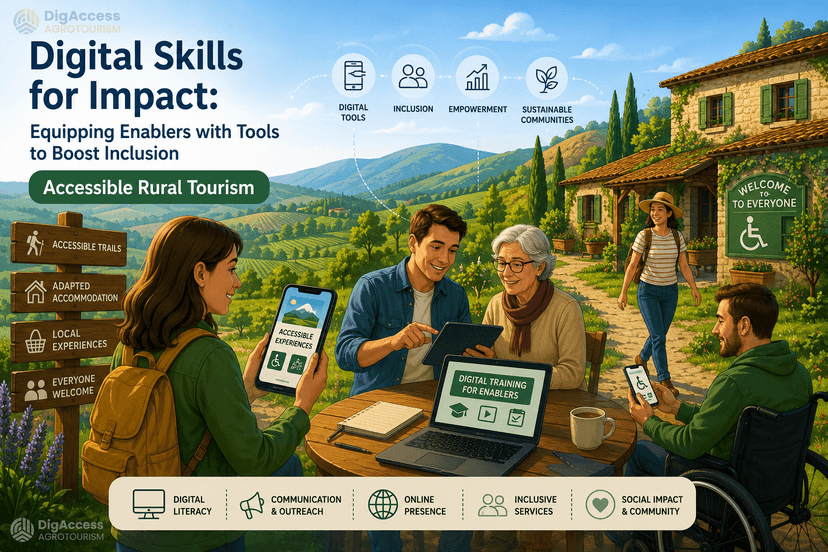
DigAccessAgrotourism has been an ambitious EU-funded project since its conception: an ambitious effort to make rural tourism across Europe genuinely accessible for persons with disabilities. Since then, that mapping has turned into momentum. Enabling Organisations (EOs) — cooperatives, associations, and support bodies that agrotourism SMEs rely on for training, resources, and advocacy — now have a research-backed framework, a trained cohort of mentors, and a hands-on toolkit to put digital accessibility into practice.
This is what “equipping enablers” looks like in practice: not a single training session, but a chain of tools that carries digital accessibility from research, to people, to everyday practice.
A Framework Built on Evidence
The first tool came in the form of knowledge. The Framework for Digital Transition and Accessibility in Rural Agrotourism, published in autumn 2025, distilled months of fieldwork into a practical blueprint. Drawing on surveys and interviews with 24 Enabling Organisations and 82 SMEs across Poland, Cyprus, Greece, Italy, and Portugal, it mapped two things at once: where agrotourism businesses stand on accessibility and digital adoption, and how ready EOs are to guide them there.
Anchored in the EU’s Digital Compass 2030 and aligned with the European Accessibility Act, the Framework did more than diagnose a gap. It laid the foundation for the capacity-building programmes for EOs and the Individual Digital Development Plans for SMEs that followed — turning research into a roadmap.
From Research to Practice: The Bologna Training
In January 2026, that roadmap became a room full of people. The project’s first Transnational Capacity Building Training brought Enabling Organisations from across the partnership to Bologna, Italy, for three intensive days on “Digital Solutions for Accessibility in Rural and Agrotourism Social Enterprises.” Run across two sessions to accommodate demand, the programme combined training on digitalisation, accessibility, business models, and funding opportunities with best-practice examples and an outdoor capacity-building activity — all designed to prepare EOs to guide SMEs, not just inform them.
The organisations that took part didn’t just attend a training — they became mentors. Bologna marked the point where DigAccessAgrotourism shifted from studying the sector to building the people who will change it.
The Train-the-Trainer Toolkit: A Resource That Outlasts the Room
Training ends when the room empties; a toolkit doesn’t. Alongside the Bologna sessions, the project developed a Train-the-Trainer (TTT) Toolkit — a practical resource that lets newly trained mentors pass their knowledge on, again and again, to colleagues and to the SMEs they support. It is the piece that turns a one-off capacity-building event into a lasting capability inside each Enabling Organisation, well beyond the individuals who travelled to Bologna.
That is the logic behind “tools to boost inclusion”: expertise that stays within reach of the organisations that need it, instead of leaving with the trainer.
What's Next: Putting Mentors to Work
With Bologna behind it, DigAccessAgrotourism has entered its next decisive phase: recruiting the agrotourism SMEs that will work directly with these newly trained mentors. Selected social economy businesses will join a structured four-month mentoring programme, receiving hands-on, tailored support to improve accessibility and adopt digital tools — part of the project’s wider ambition to reach at least 240 social economy agrotourism organisations across the six partner countries.
In other words, the Framework identified what was needed. Bologna built who could deliver it. The Toolkit made sure that knowledge could travel. Now, the mentoring programme puts all three to work in the field, one agrotourism business at a time.
Inclusion, Built to Last
What makes this phase of DigAccessAgrotourism significant isn’t any single milestone — it’s the chain connecting them. Evidence became a framework. A framework became a training. A training became a toolkit. And a toolkit is now becoming a mentoring relationship between an Enabling Organisation and an SME, somewhere in rural Europe, working out how to make a farm, a wine route, or a countryside guesthouse welcoming to everyone.
That is what equipping enablers really means: making sure the people closest to agrotourism social economy SMEs have the skills, the trained mentors, and the tools to make inclusion the default, not the exception.
No comments yet
You must be logged in to leave a comment